Tuesday, November 15, 2016

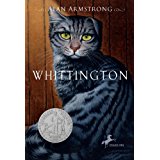
Whittington


Armstrong, A.  (2005).  Whittington.  New York: Random House.

This book earned the John Newbery Honor Medal in 2006.

When Whittington came into the lives of all the animals in Bernie's barnyard, he just wanted a place to live out of the cold.  Lady, the Muscovy Duck who was in charge, convinced the others to allow him to stay.  They all found out he was a direct descendent of Dick Whittington's famous cat.  Most of the animals in the barnyard were pets that other people couldn't feed or didn't want any more.  They brought the animals to Bernie and he would bring them home.  Of all the animals in the barn, the rats learned to respect Whittington the most, but he had to earn that respect.  He would trick them and catch them and threatened them with their lives if they didn't let the other animals alone.  He would get everyone's attention when he told the story of his famous ancestor cat.  The only human contact with the animals were Bernie and his grandchildren, Abby and Ben. Abby was older by two years and Ben was dyslexic.  Abby was to teach young Ben to read because he had so much trouble with it.  Each day the list of words grew that Ben could remember and each day the story of Dick Whittington's cat continued.  By the time Summer was over Ben was reading much better and the cat's story was complete.  The stray cat that young Dick Whittington had found was worth a fortune to those people who had rat trouble.  Fitzwarren, the man who had given Dick a place to stay, was fast becoming very fond of him.  In the end, Fitzwarren left everything he owned to Dick, the cat was lost at sea and Dick brought home two of her kittens.  He married Mary Green, daughter of Sir Louis.  They had a daughter, but he outlived them both.  He gave all of his fortune away to the poor to improve living conditions in the slums of London.

The story makes you think of people in hopeless situations.  Dick was destitute until he made it to London to find his fortune.  Whittington was lost until he found the animals in the barnyard.  It was a story of the lost being found.

Athletic Shorts: Six short stories


Crutcher, C. . (1991).  Athletic Shorts: Six short stories. New York: Greenwillow Books.

This book has been on the list of Challenged Books.

"A Brief Moment in the Life of Angus Bethune" is a day in the life of a young boy whose life is messed up by his parents lifestyle, both sets.  His mother and father divorced and married same sex partners.  His aversion to this is only the tip of the iceberg.  He is a very large young boy.  Aside from being teased by everyone about his size he really doesn't like himself.  The thing he has going for him is his feelings for Melissa Lefevre.  He has to escort her onto the dance floor at the Winter Ball and dance with her.  He finds out that she is an OK kind of girl.  She has problems too, bulimia, and likely would be as large as he is without the disease.

"The Pin" is the story of a boy named John who is slowly becoming a wrestling champion.  Everyday he eats like a wrestler, trains like a wrestler and looks at his father the ex-wrestler.  His dad has no real sense of humor and John does his best to aggravate his father so much that his punishment gets worse.  He challenges his father to a wrestling match in front of all his classmates and their parents.  It is hard, but he pins his father.  His father was upset and slapped John.  Later at home after the incident, John's father apologized for being just like his father.  No matter how hard you try, you usually end up treating your kids like you were treated.

"The Other Pin"is a story about John's friend Petey.  Petey is a wrestler also but a lot smaller and less aggressive than John.  Petey's coach wants someone to wrestle Chris Byers, the reigning champion from another school in the area.  John somehow gets the coach to believe that Petey will willing wrestle this person.  What we don't realize until later is that Chris Byers is a girl, a very beautiful girl.  Petey gets on the wrong foot with Chris, thanks to John making jokes in front of her, and he wants to clear the air.  He drives to her house one day to apologize.  They have a long talk and they both realize that they like each other.  He devises a plan to help them both. Their caveman routine gets the crowd going and ends in a double pin for their pains, but it makes Petey's school lose.  The coach isn't happy but after he runs his bleachers for the day he can head to Chris' house to take her to the movies.  He is dating his wrestling opponent.

"Goin' Fishing" is not just a fishing story, but a story of great loss and an unforgiving young man who cannot forget nor forgive another for what happened on one fateful afternoon.  Lionel, "Lion" to his friends, goes fishing with his mom, dad, and brother, Kyle.  While there he argues with his father about almost everything.  They were heading closer to shore when Lion doesn't listen to his father about something and they start to fight.  Only Lion sees the approaching boat that is coming straight at them.  He yells, but it is too late for them all except him.  He jumps out in time to see his family all killed.  Lion's classmate, Neal Anderson, was at the wheel and drunk.  Three years later, Neal comes to see him, to make it right, but Lion will still have nothing to do with him.  Neal's mother calls him pleading for Lion to help Neal, but Lion refuses.  It isn't until Elaine, Lion's friend, convinces him that if we all did what was right all the time, then there would be nothing to forgive anyone for.  Lion does go find Neal and begins to mend all the pain.

"Telephone Man" is a story of racism and cruelty that is in the head of a young boy who is not mentally competent.  He gets banned from almost all the schools in the area.  His last hope is OMLC, an all black school in the Oakland area.  He doesn't understand that he shouldn't call blacks the "N" word or Chinese "Chinks" or other  ethnicites by degrading names.  It's just that is all he has ever heard from his father so he thinks it is OK most of the time.  One day he gets into a lot of trouble with a gang of Chinese kids who cause a lot of trouble around town.  He's really sick and gets knocked down.  He wonders why he hasn't been beaten really bad and opens his eyes to find a very large black boy named Hawk talking to the Chinese gang and telling them to let his buddy alone.  After this the boy wonders if his father could be wrong about the other colors too.
"In the time I get" is the story of ignorance of the complications of AIDS.  Louie befriends Darren, a young man with AIDS.  Louie has just lost his girlfriend, Becky, to a automobile accident.  He is not ready to be friends with someone who is dying of AIDS, but can't help but like Darren.  Louie's friend Carter is a jock Quarterback who is concerned only with what he thinks not what anyone else thinks.  Louie is afraid that if Carter finds out he is hanging around with Darren, their friendship will be over.  The best thing he did was to make up his mind to do what was best for Louie, not what was best for Carter.  He became a little closer to God in that time.

All of these stories are just a little bit about what life is all about.  Giving in to peer pressure in all situations comes all to easy to those around us.  Taking a stand makes you more of a hero.
Holes


  Sacher, L.  (2000).  Holes.  New York: Random House.

This is a John Newbery Medal winner for the year 2000.

Stanley Yelnats had been in trouble before but never this much.  He was walking under a bridge when he was hit on the head with a pair of stinky tennis shoes.  The police found him with them and arrested him.  He was sent to Camp Green Lake, a juvenile detention center located on the edge of a dried up lake bed.  Stanley had a choice, go to jail or the camp and since he had never been to camp before, he figured why not???   What he didn't know was that the warden of the camp was a mean vindictive woman and she made everyone's life miserable.  Stanley made friends with Zero, a fellow camper, who helped him dig his holes (Oh yeah, I forgot to mention that each camper had to dig a 5' x 5' hole each day.)  It instantly made me wonder what was the warden looking for.  Anything found, no matter what it was, should be shown to the guards.  Stanley had found a lip stick tube and showed it to another camper who took it to the warden for a day off of work.  Zero got in trouble and ran away into the desert or across the dry lake bed.  Stanley also ran away to try to find Zero.  They almost died of thirst before finding water on top of "Big Thumb", the mountain on the other side of the lake bed.  The made it to the top of the mountain and found water and a large bed of onions.  The water and onions kept them alive for more than a week.  Then they went back to the camp to dig where Stanley had found the lip stick tube.  They found a suitcase and then the spotted lizards came out of the hole.  The warden found them with lizards all over them.  The lizards were very poisonous.  What they didn't know was that the boys didn't taste good to the lizards because of the onions.  Stanley and Zero were released into the custody of Stanley's lawyer and the suitcase had Stanley Yelnats name on it.  It had belonged to his great-grandfather.  It was stolen more than one-hundred years ago by the kissing bandit, Kate Barlow.  It was finally returned to the rightful owners.


I really liked this book.  I felt that I couldn't get enough to drink while reading it and could actually smell the peach "sploosh" that they were eating.  I guess I have a good imagination.

Superfudge


Blume, J.  (1980).  Superfudge.  New York: E.P. Dutton.

This book was a Bluebonnet Award Winner for the year 1980.

 Farley Drexel, aka Fudge, has a brother Peter and a sister Tootsie.  Fudge is 4 going on ten in this hilarious book about families in the early 1980s.  Peter says too many things around Fudge that he repeats in front of people and he has a definite mind of his own.  The family moves from New York to Princeton, New Jersey for a year so their father can write a book.  Peter and Fudge go to school and Fudge gets into a lot of trouble.  We watch Peter mature along with Fudge's pranks and Tootsie becoming a toddler.  All of the things that happen to Peter are mostly because of things that Fudge does.  In the end, they decide to move back to New York to the friends they left behind.

This book is a sequel to "Tales of a Fourth Grade Nothing" and another in the series is "Double Fudge".  What a delightful diversion in the dull routine of daily life.  Perhaps we can all attune to the frolics of a "Fudge" in our lives.  I had many happy days growing up with four younger brothers who made life very fun and enjoyable.