Tuesday, November 15, 2016

Pocketful of Posies: A Treasury of Nursery Rhymes


Mavor, S. (2010).  Pocketful of Posies: A Treasury of Nursery Rhymes. Boston: Houghton Mifflin Books for Children.

This book was on the Notable Books for Children List.

Nursery Rhymes are wonderful for children.  Parents love to read them to their children before bedtime each and every night.  I gives a feeling of coziness and allows for repetition so the child can read along with his parents. 

This book is no ordinary book.  The scenes inside the book are made up of hand sewn pictures that are unique to almost anything I have ever seen.  The artist dedicated a lot of time developing each scene into the nursery rhyme written on the page.  Each person, animal, tree, flower, house, etc. were made with love and appliqued onto a wool background that shows each and every stitch that was done by hand.  Some objects that are included in the scenes are beads, acorns, walnut shells, buttons, small logs, pieces of wood, some small china dishes and even some rocks that were applied with glue.  The scenes were then photographed to insert into the book.

Some of my favorite rhymes are included in this collection.  Some of them are not well known but reading them and seeing the pictures is very amazing.  It is definately a notable addition to any collection.

Literary Elements:
  • Style - child like in rhyme

Christina's Ghost


Wright, B.R. (1987).  Christina's Ghost.  New York: Scholastic, Inc.

Christina's Ghost is a Bluebonnet Award Winner from 1987.

Exposition: The story is about a young girl named Christina who has to spend the summer with her uncle in a large mansion on a lake in the back woods of Wisconsin.

Conflict: Christina doesn't think that her Uncle Ralph likes her and believes it even less when he thinks she is making too much noise.  She is confronted by a small ghost and has a hard time telling her uncle about it.

Rising Action:   Aside from the small ghost, Christina begins hearing noises in the attic that has her quaking in her bed at night.  At first she can hear the noise but Uncle Ralph doesn't hear them.  She finds out that the house was the scene of a double murder.  The young boy, Russell Charles, and his tutor, Thomas Dixon, were murdered by cohorts of Dixon's who felt they were doublecrossed over the theft of some rare stamps.

Climax:  The ghost of Dixon is searching for the stamps in the attic.  Christina feels that they are in danger.
Falling Action:  Russell shows Christina that they are in a comic book in the living room.  Dixon's ghost is after them.

Resolution:  They get in the car to take the stamps to the authorities.  Once they leave the perimeter of the property, the ghost disappears from their sight.  When they return to the house the ghosts are gone.

The book is listed on the Bluebonnet Award List.  Bluebonnet Awards are given to books voted on by students in Texas classrooms.  The award was started in 1979 to encourage students to read more books and this gave them an incentive to be able to vote for their favorite book.

Literary Elements:
  • Imagery - Description of noises makes you feel you are there.
  • Dramatic Irony - The ghost of Russell Charles seems to be trying to tell her something.
  • Point of View - Third person limited omniescent - We only know what Christina is thinking.

April and Esme: Tooth Fairies


·         Graham, B.  (2010).  April and Esme: Tooth Fairies.  Somerville, Ma: Candlewick Press.
·          
·         This book was listed on the Notable Books for Children for 2010. 
·          
·         Exposition:  The main characters are April and Esme. They are budding tooth fairies who are just learning to be what their parents are.
·          
·         Conflict: April and Esme were especially asked to come and get Daniel Dangerfield's tooth by his grandma.  The trouble was they were very young and had not collected a tooth before.
·          
·         Rising Action:  First April had to swim for the tooth at the bottom of a glass. 
·          
·         Climax:  Daniel woke up and they were afraid he would see them.   
·          
·         Falling Action:  They pulled down his eyelids and told him that he was only dreaming and to go back to sleep.
·          
·         Resolution:  They complete their task and head for home.  They didn't have any more problems after leaving the Dangerfield home.
·        
This book was just darling.  I really enjoyed the illustrations because it was something I feel would be in a book that I would write.  I can see why this was included on the Notable Book List.

Literary Elements:  There was lots of imagery especially the house that the fairies lived in was no bigger than a small doll house.  I also liked that they hung the teeth from the ceiling like a mobile.

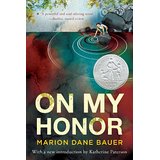
On My Honor


Bauer, M. D. (1986).  On My Honor.  New York: Bantam Doubleday Dell Books for Young Readers.

On My Honor is a John Newbery Honor Book for 1986.  It is also on the list of Challenged Books. (Death)

Explication:  The main characters of the book are Joel Bates and Tony Zabrinsky. 

Conflict:  Joel was more level-headed and not willing to risk his life for a thrill.  Tony was a dare-devil and nothing could stop him from doing something he set his mind to doing.

Rising Action:  Joel just wanted to go swimming in the local pool, but Tony had it in his mind to climb the bluff at the state park.  On the way, Tony got side-tracked at the bridge over the Vermillion River.  He decided he wanted to go swimming in the river instead.  Joel didn't really want to but was goaded into challenging Tony to a race out to the sandbar in the river.

Climax:  When he got to the sandbar, Joel couldn't find Tony.  He looked underwater for him then ran up to the highway and flagged down an older boy to look for him.  They couldn't find him.

Falling Action:  Joel went home and didn't say anything about Tony to any one.  He felt like the whole thing was his fault, Tony going in the river and drowning.  He acted like he didn't know what happened to him. 

Resolution:  Eventually, Joel did come clean and tell what happened.  He kept smelling decaying fish he attributed to the river water.  He could smell death.

This book is one that depicts what happens to young boys in real life.  There is always one in a group who will dare someone to do something foolish and another one who will take that challenge.

Literary Elements:
  • Cosmic Irony - Tony's fate was self inflicted and it was ironic that Joel was a victim of Tony's fate.
  • Metaphor - Tony was a "prehistoric monster emerging from a swamp".
  • Imagery - Joel could smell dead fish, the smell of death, even though he had cleaned himself.